Print Friendly and PDF

Monday, 1 April 2024

Eclipse of 1979 - A Spectacular Sight

One week from today on March 8, 2024, there will be a Total Solar Eclipse. News reports are full of the upcoming event and the State of Emergency that has been declared in Niagra Falls, ON due to it. I recall one on February 26, 1979 so I went back to the Reston Recorder archives online to find out what they had to say about that one.  The period of totality then began at 10:40 am and lasted two minutes and 47 seconds.  

Fort La Bosse School Board consulted with Dr. Roy Brown and discussed what they should do to prepare at a meeting on January 17, 1979.  The intensity of the light when part of the sun's surface is covered was thought to cause irreparable eye damage. Devices had been created for viewing that included boxes, welder's glass and special mylar glasses.  Dr. Brown stated the position of the Ophthalmology Society of the Manitoba Medical Association that the only safe way to view the eclipse is on television.  Given this advice, the school board passed a motion that viewing of the eclipse would NOT be allowed in any of their schools that day. Arrangements will be made to confine all students within the school in windowless rooms. (Pity to the poor teachers of the day!)  If parents chose to assume responsibility for their child's safety, they could keep them home that day with a signed letter to the school informing them. 


Text of the article above from the March 1, 1979 edition of the Reston Recorder:

It was an eerie feeling when darkness fell and the street lights came on Monday morning. This happened during the total eclipse phase when the moon blocked out the sun and left only a ring of light.
The eclipse seem to start slowly as the moon moved across the sun from the south and it became progressively darker, although even when total it was more of a twilight than a complete darkness.
Once the total period was over it seem to become lighter quite quickly.
During the over two minutes of the total eclipse one star to the right of the sun was visible. During the period of totality the temperature dropped noticeably, by ten degrees according to one observer.
For many the eclipse was a “once in a lifetime” experience and will long being remembered.
The event attracted many people to the district. At Pipestone there were two telescope set up for viewing and all along No. 2 Highway many people parked to watch the sight. A number from the United States chose Broomhill, which was right in the centre of the eclipse path, for viewing.
Birds chirped merrily before the eclipse but we’re noticeably silent during the darkness only to resume their activity when the sun came out again.
Clear skies prevailed during eclipse despite gloomy forecasts for cloudy skies.

David Braddell wrote a column for the Recorder called Outdoors Only at that time and after the eclipse, he called it "the unique experience of a lifetime".  He and his wife and their two children (junior members, fully authorized he said!) viewed the event on a ridge north of Reston, taking turns with 2 homemade viewers made with welder's glass No. 14 in box frames. He has a most detailed description in his column in the March 1 newspaper, if you'd like to read it for yourself. 

I vaguely remember being in the gym in my school in Oak River that day although some had cardboard boxes and went outside to watch. I don't recall a televsion but if there was it would have probably been a 12 inch portable one with rabbit ears and tinfoil! The diagram to the right can be found in the same paper with instructions for assembly.  
Just a disclaimer for my readers - I will not be responsible for any problems as a result of faulty assembly of the Sunscope.  You might be able to find coverage on television that day! 


Monday, 18 March 2024

That Old Familiar Sight


That Old Familiar Sight 

Clipped from Thursday, July 30, 1964 edition of The Golden Star from Golden B.C. Page 9

The following editorial was written by Russell Manning of the Reston Recorder and won the Manitoba Weekly Newspaper Association award for the Best Original Writing In the W. J. Memorial Trophy competition. 

With the advent of the water and sewer system in Reston, one should pause and consider the disappearance of that old building in the back yard which has served for so many years. This was the scene of many a decision making trip.

This was the place where one just sat and thought. This was the place where one contemplated the wonders of nature. Here was the seat of philosophy,  it will be gone to be replaced by an antiseptic throne of splendor, located in a rather institutional type of room complete with tiled walls. No longer will one be able to watch the rays of sunshine streaming through the cracks in the walls and wonder about the many particles of dust that danced in its beams. Gone too, will be that cold trip in the winter time, when one didn't pause to contemplate the wonders of nature, rather, one contemplated on getting the job done in the shortest possible time, so that the warmer climes of the house could be reached in the shortest possible space of time.

And gone too, will be the flies that have a special affinity for that place of philosophy. Ah, yes, these modern conveniences may have their advantages, but they will never replace that outdoor institution as a place of philosophy! No sir! Never!.

Sunday, 4 February 2024

E.H. Berry’s Cole Car

Stock Image from https://www.proxibid.com/lotinformation/41601527/1924-cole-sedan

Reston Recorder Article from August 1956 - Sells 1924 Cole Car

Mr. E. H. Berry's Cole car, which will be well remembered by those who lived in the Reston district in the 20's and 30's, has been sold to Ralph Welch of Roland, Man.  He took delivery on Thursday of last week. 

The eight passenger Cole sedan is a 1924 model and was purchased by Mr. Berry in 1926.  A Mr. Hurst of Winnipeg was the original owner and the vehicle cost $5210 when new.

It has a V8 motor, quite common now but a rarity in 1924.  The upholstery is a broadcloth, and it has fold down seats in the back for additional passengers. Two extra wheels and tires are mounted on either side, just forward of the front doors.  

Mr. Berry drove the car many miles, including an extensive tour of Eastern Canada.  It was last used in 1937, and has been in a shed since then.  

Mr. Welch will restore the car and its eventual destination is a museum. 


Edward Hanlon Berry along with his father Anson and brothers Fred, Harcourt, Lewis D. and Lawrence were important businessmen and builders of the area at the turn of the century.  Using the search feature in the very top left corner of this page will take you to other Historic Reston Bricks and Boards posts about the Berrys. 

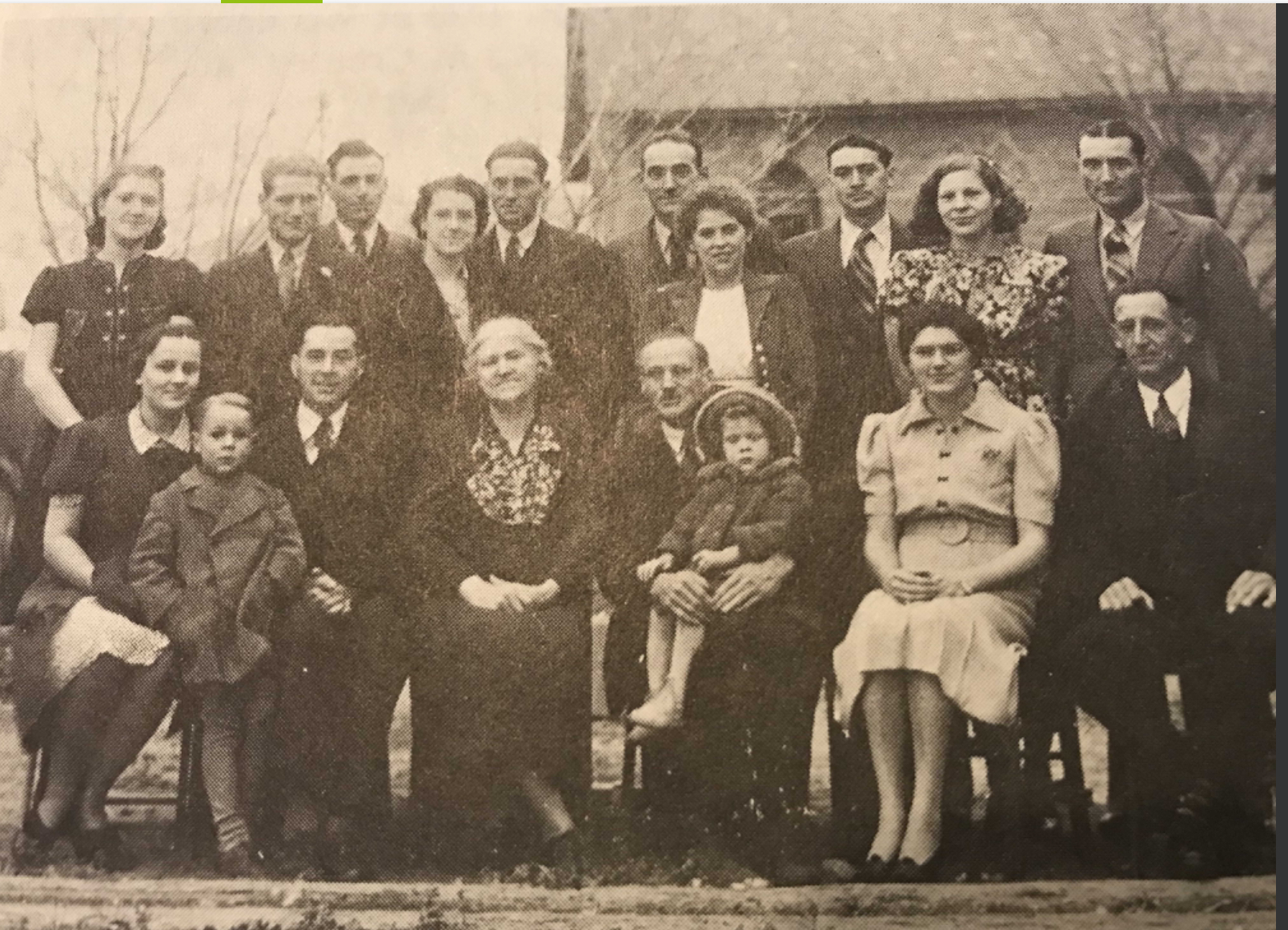
The photo below shows Bertha and Edward surrounded by their ten children, spouses and grandchildren in the 40's (copied from a post on Ancestry by Andrea Allard).  Not much wonder they needed a big car!  Further information is always welcome. 

Back row- left to right - Gladys, John, Benson, Patricia, Earl, Edison & wife Loretta, Reg & wife Gwen, Burton Front row-Wife of Egbert Dorothy, Egbert & son Floyd, Bertha, Ed holding granddaughter Gail, Marjorie & her husband Noel Clarke

Sunday, 14 January 2024

The Infamous Reston Siren

The locals of Reston today barely blink at the sound of the siren daily at 12:00 and 6:00 pm. Out of town visitors often ask - what’s that about?  I’ve been asked if I’d run across anything about it in the papers, and here’s what I found.  More information is welcome, as always. 

The early days describe the school bell as being used to get the town’s attention so I’m sure it was used for fires as well.  It was suggested in September 1906 that the school bell be rung daily at 7 am and 6 pm. The young town of Reston got serious about the need for fire protection after the disastrous fires of 1906 that destroyed the bank.  In 1910, a brick building was constructed on the southeast corner of Second Avenue and Thirds Street.  Arriving by train in September that year was a pair of fire engines, ladders and a curfew bell.  A tower for the bell was part of the design along with a night watchman’s quarters and a jail cell.  You can see it in the picture below taken from the roof of the stone grocery store in 1940.   


According to a news story in a September 1910 edition of the Reston Recorder, the brave firefighters filled an old stable full of dry straw, wood etc. was lit ablaze with the help of  coal oil to demonstrate the apparatus to the townspeople/taxpayers. When the hoses quickly extinguished the fire, it was relit with some holes punched in the building to get it roaring.  Again the flames were doused and the expense to the town was approved by the attendees. 
The December 1910 paper says the town bell is rung 15 minutes before the afternoon and evening church services on Sundays as well as for daily curfew at 9:00 pm. The Curfew Bylaw Number 461 is printed below. 


Apparently the more rapid the ringing, the worse the fire was. It was used to ring in the New Year as well as having some unauthorized use for Halloween tricks. The bell was replaced with an automated one on top of the Municipal Office.

Stories of fires in town are sprinkled throughout the years and in 1947, there were no fires according to an article.  It goes on to say that for 1948 - Jack Cuthill was Fire chief.  The committee included L. Armstrong, Les Parker, J. K. Robertson, Reg Berry, E. Robertson, C. E. McMurchy and F. R. Manning were reappointed for the following year and the following notice was printed in the paper.


Once the local telephone service was sold to MTS in 1954 for $1.00 the duty of sounding the siren went from Pipestone Municipal System employees to those from the Manitoba Telephone System as noted in this advertisement.  The local company made a profit from its beginnings in 1906 until the 30’s and was a liability to the RM after that. Those long term valued employees mentioned include Edith McDonald, Florence Holton and Les Parker as troubleman. 

 Reston remains famous for its siren still ringing twice a day, noon and six pm. Firefighters are paged through their phones now but it still rings when more members are needed. The doors to the old fire hall faced north onto Second Avenue but it was later remodeled to have the doors looking west onto Third Street. It was torn down in 1968. Vehicles grew more modernized and larger, new space was needed and the firetrucks were stored where the municipal shops are now. A new firehall was later built with several bays and training and meeting room.  The siren rings loud and clear from the Municipal Office twice a day.  In fact, it's my deadline for this story so...

Sunday, 7 January 2024

1954 Car Raffle Winner Was Numb All Over

 A look back at the online Reston Recorders from almost 70 years ago gave an interesting story I'd like to share with you today.  After many years with the old skating rink, the community of Reston attempted to build a new one starting in the summer of 1954.  I have written a bit about the history of the winter recreation buildings in our community here.  At a meeting on December 8, 1954 it was reported that $29,500 had been raised by debentures but the project was expected to cost $43,000. Alex Mennie was chair of the meeting and Reg Berry was secretary.  Harry Winch of Reston Lumber Co was the largest creditor but he expressed confidence that the liability would be met.  The committee decided to work hard to sell as many tickets as possible before the opening date of December 17.  The cost of the Chevrolet car had been recovered by ticket sales as of the meeting date and hopes were high. Almost every issue of the Recorder gave updates of progress and appeals for volunteer help.  The editorial published on the week of the opening is below. 


December of 1954 must have been a warm one like the one we experienced in 2023 since discussion about having to delay the opening was mentioned in the paper. The concern was that it not possible to make natural ice.  Someone came up with a unique solution though!
A newspaper story indicates in the end that $3864.25 profit was made on the car raffle.  I can't find confirmation but wonder if tickets sold for 25 cents each? Lucky winner Arlene McIver (now Hamilton) generously donated $100 back to the rink.  


I've known Arlene and her family since their days at Oak River in the 1970's.  She indeed did go on to become a nurse as well as a friend to many.  I'm glad I ran across this and think it couldn't have gone to a more deserving winner!

Monday, 1 January 2024

Recorder with the Answer Again!


Today's New Year's Day 2024 post tells my blog readers about a mystery solved recently by browsing archived issues of the Reston Recorder online. The surnames listed on the bronze plaque pictured above on the Archer Gate in Reston Memorial Park are ones I've run across while writing about the Reston area with the exception of one - Klingbel.  

Arthur Fredrick William Klingbeil was born December 18, 1907 in the RM of Brokenhead near Beausejour, Manitoba.  His parents, William and Matilda were Polish immigrants, arrived in Canada in 1892 and started out farming.  On the 1911 Census, the family of 3 boys and 2 girls can be found running the general store in Beausejour.  Just five years later, William is working as a machinist for the railway and continues this work for the next 22 years of his life, moving to Transcona.  The 1931 Canadian Census shows the 23 year old son Arthur living with his parents and working as a crew clerk for the steam railway. In June of 1933, a marriage record is created for Arthur and Juanita Jane Irwin in Winnipeg. The surname is spelled Klingbell sometimes but Arthur seems to go by Klingbel in his adult life.  I hadn't found much more about his life except being on Manitoba voters lists from the 1930's forward.  Arthur died at age 80 in Winnipeg on October 26, 1988. He is buried with his parents in Beausejour Cemetery. But why is his name on the Archer Gate in Reston 
 due to a contribution to the Park of $1000? 


It was the spring of 2022 when the RM of Pipestone finished digitizing the Reston Recorders and made them available free online.  I've spent many hours since then reading up on people and events from 1905 to 2018. The link to the archive list of issues to browse is here: https://www.rmofpipestone.com/p/reston-recorder-archive  The January 18,1989 issue has the rest of the story at the top of the front page!  I can't help think that times have certainly changed.  I am picturing a friendly Reston citizen or perhaps Alfred Archer himself making Arthur Klingbel feel welcome enough in our Park that he left a gift to it in his will 3 decades later.  The inscription "A Friend to All" was written on his gravestone and his generosity is now remembered here as well. Thank you, Mr. Klingbel.  

Friday, 12 May 2023

Practically Everybody Interested in Oil


Wow!  I'm not sure which font size was used for this headline in the Reston Recorder on February 21, 1952 but it couldn't have been overlooked! You can click here to browse the 1952 papers online and see various stories about drilling activity, rumours of strikes and reports of dry holes.  Seventy years ago, the Reston area was agricultural but that was about to change.  With the exploration for oil around Virden in the late 40's and a big discovery in 1951, Reston and area residents were excited to see if the deposits went further south.   The headline making well was located on the farm of George and Ellen (Wilson) Walker in the Prairie Rose District  on SE 21-7-28.  Although the well was soon capped and did not produce as anticipated, the Walkers took a trip back home to Scotland, 44 years after coming to Canada. Can you just imagine to tales they could tell their old school chums of their experiences in Canada? Their real treasure would have been their five children, many grandchildren and today the multitude of descendants who have made their own marks in the world. 

Caption: Mr. and Mrs. Geo. Walker Sr. reading the news of the spectacular oil strike on their farm.  The strike set up a blaze of publicity which made the couple known from coast to coast. The outcome of the well is in doubt, but in any case, the couple have benefitted.  Sale of half royalties amounted to $6500, enough to pay off the mortgage, and leave a few thousand in the bank. 
Photo Courtesy of the Winnipeg Free Press.  March 1952


Gwen Simms and Jim Milliken 1947
I do have a physical copy of this historic Reston newspaper thanks to my cousin Marilee.  Her Mom Gwen (Simms) Milliken had handwritten a note on the top of it to her Uncle Bill Sinclair from Oak River. 

Dear Bill, This country may be “stoney and scarce of bluffs”, but shows signs of much greater things underneath.

 I saved this paper especially for you as I knew you’d be interested in hearing it and had said the same thing.  Love your soon to be wealthy niece, Gwennie

There was no doubt of some ongoing joke between the two about Jim's family choosing  stoney and treeless homesteads in Pipestone rather than God's Country at her family's home at Oak River. 😊 


The title for today's blog post comes from an article that I stumbled across on the Peels Prairie Website here .  It was clipped from a 1952 newspaper in Irma, Alberta which is now a tiny community 90 minutes east of Edmonton. I'm not sure why they picked up the story written for the Brandon Sun by John McNaughton but everybody is interested to read our own history from another perspective.  Practically everybody at least. 

Sunday, 7 May 2023

Bonniman the Drayman

Today's post introduces us to another long term resident of Reston whose contribution deserves to be remembered.   Chester Gordon Bonniman was born in 1881 in Woodstock, Ontario. At the age of two he came west with his family to build a new life. His father Alexander was born in Scotland, where their surname was spelled Bonnyman, and came to Canada at the age of 18. In 1883, Alexander, his wife Sarah Eastman and two little boys Franklin and Chester  purchased a farm in the Lambton district northeast of the present town of Reston at 14-8-27.  The school was built on the corner of their land in 1889.  Two girls and a boy were later born into the family.  In April of 1926, Chester Bonniman purchased the livery and coal business from McMurchy Brothers - Colin and Archie Jr -  who began the Ford vehicle business.  The livery barn had been built by Colin Campbell Sr in the early days of Reston when he was a horse buyer and seller and ran a livery barn. It is just out of sight at the far right of the picture below, by the piles of wood. 


Corner of Railway (First) Avenue and Fourth (Main) Street looking north from the top of the elevator


Completes 21 Years of Service -1947

Mr. Chester Bonniman who for twenty-one years and three months carried the mail from the Post Office to the station made his last trip on Monday, June 30. Mr. Bonniman in all that time has never failed to meet the trains.

Officially Mr. Bonniman has been the mail carrier for the past twenty-one years, the extra three months is accounted for by the fact he took over the contract from McMurchy Bros. 

 The new mail carrier is Norman McCartney


Amy Law was born in Dewsbury, Yorkshire England to Samuel and Louisa Law. She came west from Ontario with her family but upon the earth death of her father Samuel in 1904, the family took up homestead in the Fry district near Antler, SK.  Amy met the young farmer Chester Bonniman and they were married in 1910. Chester's parents moved to Virden and the young couple took over the farm. In 1927, looking for a new challenge, they rented out their farm and took over the McMurchy draying business in Reston.  Draying has evolved into trucking and along with getting things from place to place, he sold coal and wood for heating.  Hauling pails of water and blocks of ice to houses in town for 5 and 10 cents was an important part of his business as well. Advertising was important to Chester and few weeks went by without his box ad in the Recorder. 


June 1947 New Team

No doubt you have noticed the well matched team of blacks that haul Mr. Bonniman's dray. The new team are Prince and Maud. They replace the well known bay team which gave such a good service for the past four years. Mr. Bonniman told the Recorder that it takes only a few weeks to break a team into the draying business. In time the horses get to know the route and they require little handling. Mr. Bonniman told us of one team he had which he left standing for a whole afternoon and when he got back they hadn’t moved an inch.


First (Railway) Street looking east from the top of the elevator - about 1960

The livery barn that Mr. Bonniman purchased from McMurchy's burned in a fire in the 1930's.  the buildings on the right of the photo above were built to service the Coal and Wood dealership as there was less need for a livery barn. The dray team would have used the eat doors in the bigger building and being just down the street from the train station was convenient when he carried the mail from there to the post office and back all those years. 


It was announced in the Reston Recorder on November 2, 1949 that Chester was retiring from the coal, wood and draying business after 24 and a half years. He sold to George Cheyne Jr, who had been working for him since returning from WW2 in 1944. 


Chester and Amy's only child  Irene Rose was born in 1914.  She married John Oberlin later in life and lived and farmed south of Reston for many years. Fletch Manning wrote in the Recorder about the history of the Bonniman House across from the Memorial Park back in 2004. Chester died in 1951 and Amy in 1960. 

Thanks to Ancestry user lindacarlson_1 for allowing me to use the portraits of Chester and Amy to help tell their story.

Monday, 10 April 2023

Bee Keeper Bert Stratford

This post is not about a building but a long time resident of Reston.  In pages of the online archived Reston Recorder, I ran across a few facts about his contributions and legacy.  If someone out there has a better picture of Bert and Minnie Stratford, I’d love to include it in this post. ssimms@escape.ca 

Robert George Stewart Kitchener Stratford, known as "Bert" was born in Surrey, England in 1900.  Bert once said his 4 given names were in honour of British Generals of the Boer War.   The family immigrated to Canada in 1908 to the Austin, MB area where his father George along with his mother Marian and 6 siblings got a new start.  George was originally a farm labourer but later worked on the coal dock in Austin.  


From the Reston Recorder November 1948
Bees aren’t so tough to handle? Not at least for Bert Stratford, who has over 100 hives of them and never thinks of wearing gloves when working with them.
Bert took the writer on a tour through his colonies and when it was all finished your reporter knew a little more about the way honey is gathered. For instance, a good swarm of bees contains from 70,000 to 90,000, and may harvest over 200 pounds of honey, provided the queen rules the roost the way she should.

It all depends on the queen, according to Bert. If she makes the workers step they gather a lot of honey, but if she is the indulgent type, well, they kind of get lazy on the job. Pointing to two hives of about the same strength, he explained that because one had a good queen they had gathered a lot more honey than the other.

Queens live from 2 to 3 years, while workers, when the queen is driving them, last only six weeks. However, In the winter the workers live a lot longer, for during that season the queen permits them to eat and they don’t have to work.
Bert had enlisted in WW1 in March of 1916 and subtracted a couple of years from his birth date to be able to do it.  His service file indicates his correct birthdate was discovered once he was overseas so he became part of the YSB (Young Soldier Battalion) who were trained for jobs like orderlies and construction but kept off the front line for the most part.  He was demobilized in 1919 and married Minnie Ball from Napinka in 1921.  The newlyweds arrived in Reston that same year1 where he worked on the coal dock for the next 27 years.  Buckets of coal needed to be winched overhead in from the dock to the train. Later, the coal was raised to the overhead bin by power but unloading to the dock was still done by hand.  Once diesel engines arrived in the 1940's, his job became obsolete.
 

The ever resourceful Bert had a Plan B so purchased a farm at SE 22-7-27 along the Pipestone Creek just east of where the Canupawakpa Walking Trail is now, farther east of  Harper's Grove as written about hereHe owned the quarter from 1945 to 1965.  Bert learned the bee keeping trade and his beeswax and honey won many prizes including first at the Toronto Royal Winter Fair.  The 1948 Reston Recorder article continues below.  
One of Bert’s chief gripes in his business is people saying ‘ you must be making a lot of money’. Burt pointed out that the cost of supplies has advanced tremendously, while the price of honey has dropped. Packaged bees which must be bought in each spring to replace hives which have died over the winter, now cost over six dollars they used to be three dollars. Foundation for the combs now cost $.90 a pound, against less than half that amount a few years ago.

In addition to the cost of supplies, there is a lot of work connected with the beekeeping business. For instance, It is necessary to go through each hive every eight days during the honey season, no small chore. Other tasks involve the moving of the bees, and of course the job of extracting the honey, which is when you find whether there is to be a profit or not.
Bert and Minnie's first home was two boxcars, set about where the Elliot Brothers (former Pool) elevator stands today in Reston.  They later lived on the west side of First Street, just two houses north of the tracks. The coal docks were conveniently right out his back door.
 
Bert did carpentry as another hobby and the Reston District Museum was the beneficiary of this skill in 1970’s when he made frames for the many pictures that were in the museum.  He had collected and restored many First Nations artifacts from his farm and these can be found in the museum as well.  

Bert passed away in 1977 and Minnie in 1986. They had no children but left much of their estate to benefit the Reston community.  The Memorial Park remembers them with their names on a bronze plaque at the main west gate.  Other beneficiaries included the Hospital Aid,  the Museum, Lions Club and the two churches - United and Anglican. 
A quote attributed to the Victorian poet George Eliot seems appropriate to remember the Stratfords. 
Our dead are never dead to us, until we have forgotten them.

Wednesday, 29 March 2023

Millinery at GS Munro’s in 1910


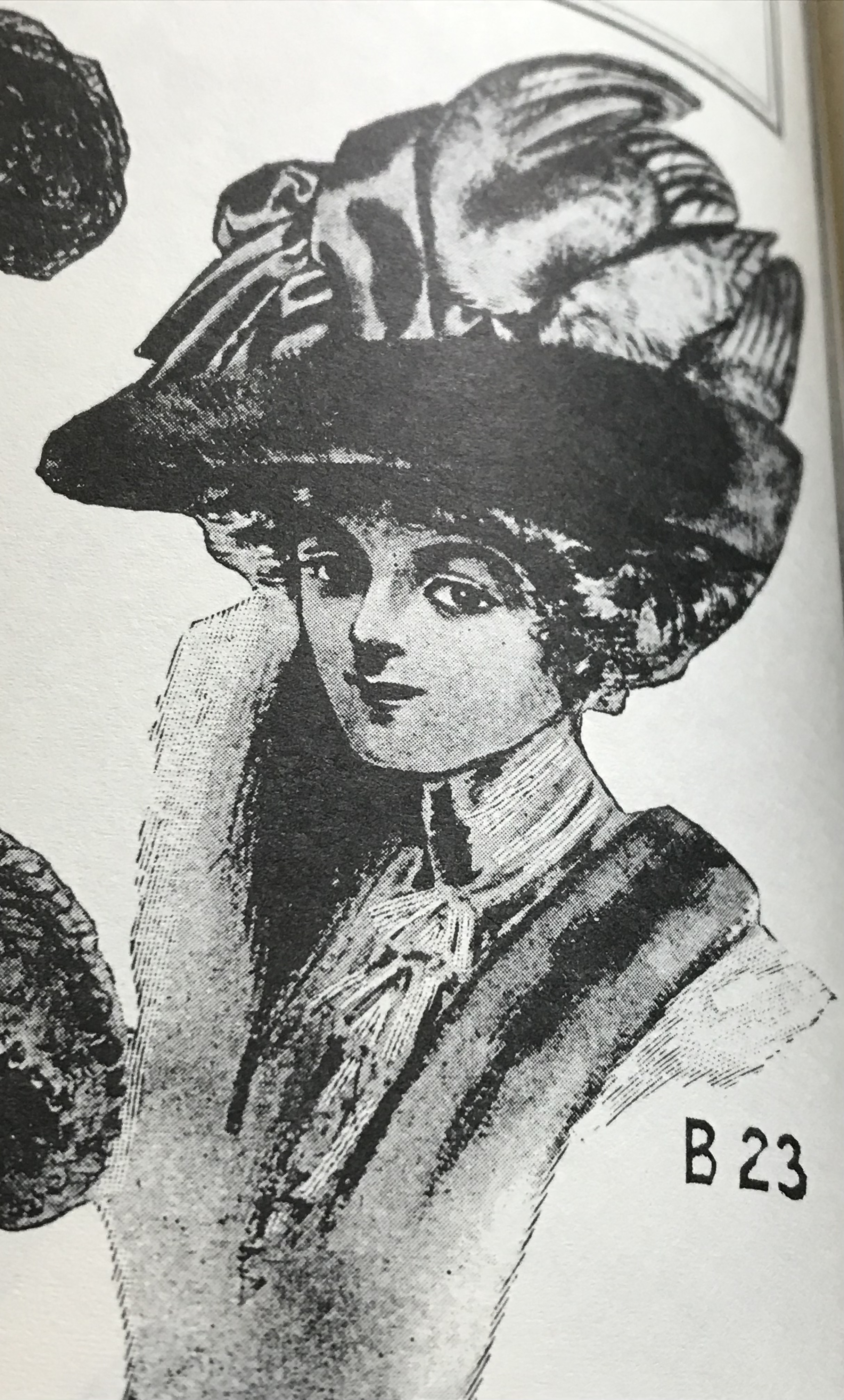
Today's post gives a glimpse inside the G.S. Munroe store in Reston, Manitoba in October of 1910. The impressive two story stone clad store would have been 8 years old and sold a variety of merchandise to the growing town. On this particular day, a display of the new hats for the fall season was being held. Pictures and descriptions of ladies' hats found in the Hudson’s Bay Catalogue 1910-1911 at the top of the page give us an idea how fancy the headgear was in those days.


October 6, 1910 Reston Recorder Page 8

 The opening days at Munro‘s on the 3rd, 4th and 5th, both from a standpoint of attendance and the sale of ladies’ headwear, were most successful. Miss Whitely, the popular milliner, and her assistant Miss Grace Shippam, had on display, a choice collection of ladies hats that brought them much deserved praise. The large sale that resulted was most gratifying.

A description of the new styles, in a short space is impossible, but the following points may prove of interest to our lady readers who have been unable to attend the display.

In the larger hats, for young or middle-age ladies is the “La Cloche” made in paon silk velvet, trimmed with black taffeta silk ribbon.

A stunning creation in a small hat is made with a sloping stovepipe shape and made in paon silk velvet. The crown is draped and a large wing poses on the left side.

A beautiful feather band turban the crown draped with shirred satin ribbon, with a large bunch of ribbon caught up on the left side was one of the creations that had a host of admirers.

Another popular hat is one trimmed with marabout and roses. The rim is of silk velvet and is faced with moire silk ribbon.

The most popular colours are royal blue, brown, black and white and catawba.

Many of the ladies, after inspecting the millinery display and choosing their season’s apparel, attended the demonstration given by the Gold Standard demonstrator, and received many useful hints regarding the use of Gold Standard Products.

Reading these old articles has me doing some researching to help me put a picture to their words! "Paon silk velvet" seems to be a term that has faded into history but ladies of the time knew it must have been special silk.  "Moire silk ribbon" has a watered or woodgrain type pattern on it.  "Marabout" trim may have been misspelled from marabou which is soft downy feathers of a young turkey, dyed different colours as decoration. "Catawba" coloured hats? What would I do without Google??  It is described as a medium shade of dark pink-red.  Huge hats like this were kept in place with hatpins, which have become collector's items. 

Trails Along the Pipestone 1981  has a photo on page 491 of the millinery department of G. S. Munro Store in 1920 featuring Miss Cutting and Miss Mabel Abercrombie set up on the second floor.  Other Reston milliners over the years include Miss Levers, Gilles, and Mrs. T.W. Boulton (her husband was a distant relation, I think!). 

Lottie Smith, daughter of Thomas and Maggie Smith of Sinclair, was another who learned the millinery skills. Her niece Pat Taylor tells me that she worked in Salisbury's Millinery Shop in Reston in the 1920’s. Miss Smith made and sold millinery, ladies clothing and operated an ice cream parlour in the little old butcher shop until 1927 when she moved to Winnipeg. She remained a spinster her whole life as did her sister Minnie.

The wife of Dr. Clark, Winnifred, sold hats above the drugstore and later the bank in the 1930's. Fashion hats were worn less and less during the Second World War and by the 1970's were almost never seen.  The Catholic Church no longer required head coverings in services in 1967. One interesting website says this was due to shorter hairstyles but often hats were also worn to keep the sun off a woman's face.  The British royals and the Kentucky Derby have kept hats and fascinators in the news recently but they are a niche market.  

Were your curious what Gold Standard Products were? Google searches didn't find much but this ad from Munro's store the week before the millinery event makes it sound like the beginnings of a Watkins type company with many products to flavour and simplify home cooking. How many in the crowd that day in 1910 came for the hats and how many for the baking demonstration? 

Sunday, 19 March 2023

The New Fangled Egg Grading Machine 1948

Here's a little knowledge today to go with your Sunday morning eggs!

 A previous post about the Reston Creamery here does not mention another part of this business that included the sale and raising of eggs and chickens.  An Egg Pool had been set up in the basement of Berry Hardware and later in the Cates block for farmers to bring their eggs to be sold to locals without their own birds. With the opening of the Reston Creamery in 1946, there was soon to be eggs bought and sold there as well.   The following article from April 1948 in the Reston Recorder explains how an automatic egg grader works.  So many things that had been done by people were being taken over by machines and the citizens of the times seem amazed. 

Recently installed in the Reston Creamery is an automatic egg grading machine. The machine, which speeds the grading of eggs by fifty percent, is practically fool proof, does everything but lay the eggs.

Operated by Jean Dooley and Marian Jezzard, the speed with which eggs are packed and graded is a sight to behold. Jean is in charge of the operations. She takes the eggs from the crates as they are delivered from the farms, candles them and separates them into A, B, craxs or rejects. "A" eggs are then placed on a inclined slot, where they roll down into the grading machine. There is another slot for B and a third for craxs.

Once placed on the machine amazing things happen. Rolling down the slot, the machine admits one egg at a time into the grading machine proper. In the A line up the first thing that happens is the machine prints each egg with a Canada stamp. The eggs are then moved forward by means of a moving trough. The first stop is the scale, the trough recedes and the egg sits on a miniature scale. If it is heavy enough, the scale trips and the egg rolls into a tray labelled A large. If it is not heavy enough for this classification, it moves forward again to a further set of scales, until it is finally deposited into the right classification tray. A eggs are classified into A jumbos, A large, A medium and A pullet. B eggs move down the other side of the machine. Here the same process as with the A grades is repeated. However there are only two scales on this side of the machine for B or C eggs. Also these eggs are not printed with the Canada Stamp.

The packing of eggs for shipment to the market is in charge of Marian Jezzard.

An interesting side note to this story is that Miss Jean Dooley from Hartney not only found work in Reston, she found love too!  Jean was married to Marion's big brother Frank Jezzard in April of 1949 and went on to raise a family and be a part of the community at Linklater and Reston.  


On the same topic but in another town, the above 2 Egg Statements were issued to my paternal Grandmother, Mary (Sinclair) Simms, at Oak River during the same time period.  Looks like B eggs were what her hens hens laid most of but if I'm reading the yellow one correctly, (and tell me if I'm not, Dad) Grandma received $5.76 for 24 dozen eggs! Crazy when I snapped up an 18 pack in the store last week because they were on sale for $5.99.   ðŸ˜²

Monday, 13 March 2023

Harper's Grove

Last week's post about Guthrie's Grove picnic spot has led to one this week about Harper's Grove.  Also, a recent blog post about the Reston Citizen’s Band mentioned a performance  put on by them at a Royal Templars of Temperance picnic at Harper’s Grove in 1909. I had so many questions! Luckily, blog reader and former Restonite Tom Dempsey messaged me with some helpful information.  More about that later. 


According to the Trails Along the Pipestone history book on page 814, SE 21-7- 27  was first claimed by J. McKinnon in 1885.  A. Wilson owned it next in 1889 but G. A. Harper owned the quarter from 1916 - 1947. 
George Alexander Harper was born in Bruce County, Ontario and married his Scottish bride Isabella Farnie in Winnipeg in 1912.  He and Bella lived 2 miles north of Reston on the banks of the Pipestone Creek and were credited with clearing the picnic grove that bore their name and had a swinging bridge over the creek to access their land on both sides. Census returns over the years show they often had at least 4 people living with them to help work their land and with the housework. They garnered a reputation for being very generous and hospitable people over the 4 decades of their residence. A nephew of Bella, Arthur Kingsley Farnie came from Scotland to live with the Harpers while in school.  He later joined the Royal Canadian Airforce and was killed at age 20 overseas in 1942.  The Harpers had one daughter Lily who married a local boy, Jimmy Forman and they moved west to run the general store in Wells, B.C.  George and Bella held a farm auction sale in October of 1948 and moved to British Columbia themselves.  The sale ad is a large ones and includes everything - horses, cattle, poultry, equipment, furniture, the piano, home canned fruit, a buffalo coat and so much more.  


Next on the scene were newlyweds and locals, Thomas Leslie "Les" Dempsey and Frances May Pierce.  They farmed here for the next 2 decades. Their only son Tom was able to fill in some Harper's Grove details for me. He grew up on the farm and recalled the picturesque spot. 
The picnic grove itself was in the small "peninsula" of land, approx. 60 yards wide and 125 yards long formed by the Pipestone Creek, past the house, north, around the bend then south towards the barn and on eastwards to the bridge. When I was just a little fart, the anchor posts for the swinging bridge existed on the east bank of the creek approx. 80 yards north of the barn.
In June of 1967, the Dempsey family were honoured at their own going away event.  A clipping from the Brandon Sun tells the program included singing, recitations and duets put on by friends and neighbours.  They had been active community members in the church and curling.  Retirement in Kelowna were enjoyed for many years and both returned home, to be buried in Reston Cemetery.

Next to own the quarter was Melvin Watt who purchased the farm in 1969.  In 1971, he married Rosealine Ann Cop from Antler, SK and over the next several decades they both contributed greatly to community life with their work on various boards. Mel and Rosealine raised a family of two girls and a boy and grew pedigree seed for sale.  Their yard site was a showplace and you may recall seeing when it was featured on the Prairie Farm Report on TV. In 2005, the Watts had a partial farm equipment auction and semi-retired to spend more time in Arizona and doing things they loved.  They are gone now. Their family rents out the land and occasionally enjoy an afternoon relaxing along the creek as was done over 100 years ago. 

Each quarter of land can tell a story of its past residents and I've been glad to tell this one.  Any further details and photos are always welcome!