Print Friendly and PDF

Monday, 31 October 2022

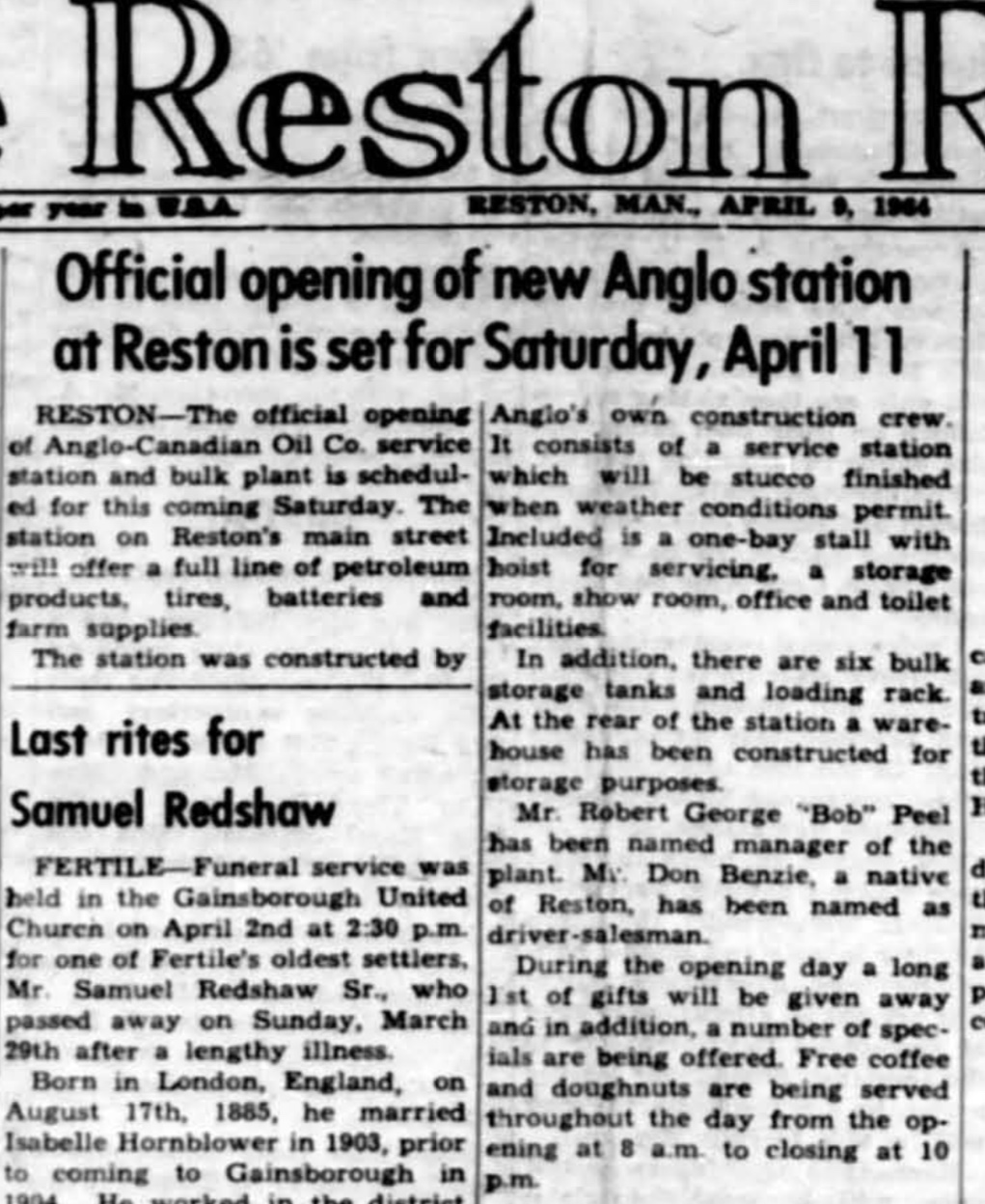
Anglo Oil Service Station


 1964 was a year of frenzied building in Reston.  After the disastrous fire in November the year before, a new rink was being built along with a post office, another gas station and at least one private home.  The first to be opened was the current Petro-Canada station on Main Street. The property had been a tennis court when it was owned by the lawyer who lived across the street, Kippen Cates

Anglo-Canadian Oils Ltd was established in 1939 and was very committed to small town service stations in 1964, the company had 384 employees, according to an interview with president J.L. Valena and half of that number were employed in towns in rural Manitoba.  They also a refinery in Brandon, where the Canadian Tire stands today where a million barrels of oil were processed in 1963. Crude came to Brandon from Alberta and Saskatchewan via the Interprovincial Pipeline. Manitoba crude was not suited to the equipment at this plant, apparently. 

Bob Peel was the first manager of the station and Don Benzie drove the bulk fuel truck and was a salesman.  Fred Paul's name is also connected to the early days of the Anglo Station. 


In 1966, the business  was rebranded as Royalite.  Bob Froese was manager in 1972 and along with Jim Pringle, had the business called B &J Gulf.  Other names associated with the garage over the years are Dale Mayert, Jim McLenehan, George Pringle and Vernon Cook.  In 1986, Petro-Canada took over Gulf as a crown corporation and Barry Caldwell was installed as the manager of Caldwell Sales and Service with operations in Melita and Reston on December 8, 1986.  Jack Smith was hired as a driver salesperson for bulk fuel.  Petro-Canada became a private company again in 1999. 

October 2022

Saturday, 22 October 2022

Do you recall Power Toboggan Races and Potatoes?


April 2, 1963 was a historic evening in the Sportsman’s Room of the Reston Hotel.  Reston Lions Club was officially formed with Henry Claussen elected president. Sixteen members signed up that evening and the club soon grew with many more energetic Lions. They planned to meet the first and third Tuesday each month with one of those being a supper meeting. 

The Reston Lions Club was a very active group in Reston in the 60's and 70's.  Many projects were taken on by their crew of fundraisers and builders.  Mentioned previously in this blog include The Alstone Lodge, The Reston and District Museum, and the basement of the Reston Memorial Theatre.  They were instrumental in installing artificial ice in the rebuilt 1964 Rink now known as the Rec-Plex.  The Reston Lions playground on Main Street beside the bank was their centennial project in 1970.  It was at their push that got the Willowview personal care home started in the mid 1980’s. Tennis courts in the Park and Skeet Shooting at the fair grounds were supported financially.  An annual Seniors Christmas supper was another of their projects. Along with their projects, they are fondly remembered for their unique fundraisers starting with a dunk tank at the fair that first year of 1963.   

Power Toboggan Races were held for the first time northeast of Reston at Burton Berry's farm in 1969.  Ads reprinted below from the Reston Recorders online tell the story. Alex Watt was also advertised in the classifieds looking for a copper boiler to make coffee for the event.   

Profits from the day were pegged at $200 with 36 machines entered in 11 races. Three Sno-Sport machines were entered by the factory in Winnipeg and a number of Sno-Jet machines were shown by Art Belisle of Antler, SK who was a dealer for the machines. Classes included Children' 12 and under, Children 18 and under, Powder Puff (women drivers), classes by horsepower, open classes, Fat Man's race (?) and Cross Country.  Archive papers from 1970 indicate the race will not be held that year and may not ever be held again.  Hmmm - so many questions!

Reston Lions Club members were fundraisers were often ambitious and their potato crop was one that is well remembered. It was first tried in 1969 and the Recorder notes that thousands of pounds were grown in an area of just over 2 acres on 55 rows. It was a challenge initially when every family had their own idea for how the seed should be cut and the best way to tend the plants! Lions Club members and volunteers were assigned their own row or rows and competition took over to encourage the biggest harvest possible come October. All work was done by hand and shovel but as the fundraiser continued and grew, planting and harvesting machines were purchased by the club.  

Sometime in the past 20 years, the Reston Lions Club ceased to exist although some of the members joined the active clubs in Sinclair and Pipestone.  However, their mark was made and their contributions to the community are remembered!  

Sunday, 16 October 2022

The Matter of Privacy at the Hospital

Welcome back for another fall and winter of Reston, Manitoba history.  Do you have any ideas or pictures for future blog posts?  I'd love to hear them!

A previous post about the Reston District Hospital is here but browsing through archived issues of the Reston Recorder this summer (https://rmofpipestone.com/p/reston-recorder-archive) turned up some more information and pictures.  Photos from the scanned microfilm and not very sharp but it’s something! These 3 were taken by Verne Glass on grand opening day when the public was invited in to look around and have tea. 


Reston hospital was officially opened on December 15, 1951. Community donations toward the building amounted to $4212.20 including $2000 from the Reston Memorial Theatre and $712.20 from the Masonic Lodge. A donation of 2 scales was made by Jim Sing of the Modern Cafe. The Reston Unit of the Hospital Aid was tasked with furnishing and buying equipment for the new hospital. It had 4 wards each having 2 beds, a case room, a nursery and nurses beds, staff dining room and kitchen on two floors. 

The community, and especially Dr. Chapman, had been promoting the idea of a community hospital since the flu epidemic of 1919 but homes and hospitals in surrounding communities were used instead. Finally in 1951, construction began at the far west side of town along the highway.  Reading through the past issues, listing of names of patients admitted and released were printed weekly.  it seems strange and lacking privacy according to today's standards although I recall seeing similar in the Minot, N.D. paper.


The hospital admission and discharge lists stopped in early 1969 and I was curious at to why.  Luckily, my questions was answered in the two Letters to the Editor below!


Lastly for today, the clipping below from 1970 certainly has a familiar ring to it.  I guess history is indeed bound to be repeated! 


Saturday, 14 May 2022

Reston Recorder

The most important record of this area is contained in the pages of the Reston Recorder.  It is an exciting and long awaited day for me today to share with you that a group of these pages are available to everyone to browse online here. Choose a decade, then a year, then an edition and scroll through our past! (After you are finished reading this post, of course.😉)


Page from 100th Anniversary edition August 6, 2005

The history of the newspaper in Reston began in 1905 when Frank and Arthur Manning heard about a fledgling town on the prairies of Manitoba that was in need of a weekly newspaper.  The first edition was printed on July 25, 1905 and soon elicited 500 subscribers at $1.50/year.  It consisted of an even number of pages about half of them being local news and advertisement and the other 4 called ‘boiler plate’, national and regional news. Columns with news of district citizens had titles like the Lambton Lights, Ewart Echos, Belses Breezes and Clover Hill Clippings. Hockey, curling and baseball results, the local hospital admissions and discharges, classifieds and block ads for local businesses as well as those from Pipestone, Tilston, Sinclair and more each had space in the Recorder. 


In 1906, Arthur Manning left the day to day operation of the paper to his brother Frank and he became the principal of the local school.  That same year The Peanut on the Reston-Wolseley rail line began and with it a huge influx of workers and new businesses to support them. The first location chosen for the Recorder business was on Fourth street, where the Hairline Beauty Salon is today.  That building was built by J.B. Stallwood and later became the home of Helen Ready (nee Manning). More room was required so in 1907 a new office was built using the same brick as the Roundhouse. It sat along Second Avenue near the present Drop In. In 1966, a building was moved into Reston to be the new home of the Recorder.  It had formerly been used as a church at Bardal and Isaac Implements at Cromer.  This building is now listed for sale https://www.realtor.ca/real-estate/22824971/330-fourth-street-reston


Along with the weekly newspaper, the Recorder was the local printer of all sorts. Auctioneer John Baldwin had flyers made to advertise his upcoming sales. The annual fair prize list and church financial statements were eagerly awaited by local citizens to be 'hot off the press'.


Subscription Reminder - 1940's perhaps

From the Regina Leader Post - March of 1950 

Two Papers Are One While Bonspiel Runs Maryfield, Sask., (Special) 
When Rusty Manning, editor of the Reston Recorder, and R. K. Harris, editor of the Maryfield News, participated in the recent bonspiel at Reston, the matter of printing their respective papers became a problem. Putting their heads together, the two editors came up with a solution, amalgamation. During bonspiel week the two papers came out as one joint effort with the printing done at Reston.

Frank Manning (1870 - 1945) had married Frances Lauretta Robinson in 1901 and they had 3 children - Helen (later Ready) , Wilma (later Pierce) and Russell. Arthur James  (1875-1949) married Marion Robertson in 1912 and became a school inspector living in Carman. He returned to Reston in 1945 to help Helen run the paper after the sudden death of Frank. Russell (1913-2003) worked at the paper from a young child except the war years of WWII when he as overseas.  Upon his return he was editor and publisher until his retirement in 1979.  Russell was a well-known sportsman in curling and golf and a enthusiastic duck hunter.  Gary Smith started as and was a editor and manager from 1980 until his death in 2002.  Bruce and Ingo Schwanke were next to head the Recorder and it became a part of Corner Pocket publishing under Bruce in 1996. In 2007, the new owners were Glacier Media Group.  The paper temporarily closed due to the pandemic in March of 2020 but by October of that year, the decision was permanent.  You can read the final word here. Besides editors and publishers, many many employees over the years contributed their blood, sweat and tears to get the paper out on time. 


When the Manning brothers began their paper in 1906, I wonder if they could imagine their news one day being available anywhere in the world at the click of a mouse.  All my wonderful Historic Reston Bricks and Boards readers now have some local history to peruse while I give myself the summer off.  There will be many more stories to tell from these pages.