Print Friendly and PDF

Sunday, 5 February 2023

Wooden Curling Rocks, a Rink that Blew Away and Prizes

Curling began in Reston in 1897 according to a history in the December 17, 1964 issue of the Reston Recorder.  The history of the 4 Reston Rink  buildings can be found in a previous post hereThe January 15, 1948 Reston Recorder is quoted below: 

Do you remember when the Reston curlers used wooden blocks instead of rocks? What they did in the days when curling first started in Reston, when the rink was situated on Railway Avenue, back before the turn of the present century. Tom Mutter was one who curled in those days and he is still at it. In mentioning these days, Tom stated that not only did they curl with wooden blocks, but the members of the club turned out and assisted in the manufacture of the blocks. They were made on a wood turning lathe, which was hand powered and each member of the club helped the club provide the power in turning the lathe. The blocks were about twice the size of our present day curling rocks and were made of cedar. They were hollowed out and lead was poured in the depression to give the blocks weight. Fitted with ordinary curling handles, the wooden blocks made acceptable curling instruments. One of the advantages was that a follow through shot could be made. With a fast rock and a square hint it was possible to end up on the ice even though the hit rock was in front of the house. Tom said we had more fun with the wooden blocks than we ever had with our present day curling stones.
Wooden curling rocks were used that first year until as guests at Pipestone, the men saw they had granite ones.  Not to be outdone, some individuals purchased their own the next winter at a cost of $18/pair. Apparently, the old wooden curling rocks are buried in the lot where the old rink was which is now a garden.  Careful when you are rototilling Kenny!

Private granite rocks were used and kept in locked wooden boxes between games until the 1930's when the curling club offered to have those rocks sharpened if the owners would agree to leave the locks off the boxes.  Apparently, the offer was accepted by many.  With the building of new facilities, club rocks were among the purchases and two different colours of handles were possible.  Interesting to think this was not needed previously!  The price of the new 1964 rocks was $94/pair. A quick google search tells me Scottish granite curling rocks can cost $700 each today. 

Thanks to Bonnie and Kay for this undated picture of the club at nearby village Ewart. 

The town of Ewart is the true definition of a railway town. Settlers were living in the area since the late1880’s - Eisner, McMunn, Nolan, Ryland, Zarn, Gudmundson and Stone to name a few. The settlers patronized the centers of Reston, Virden and Sinclair and mail delivery was in Bardal. Everything changed in 1905 with the building of the Reston-Wolseley railway line. Ewart was the first stop after Reston on the way northwest and soon stores selling groceries, meat, lumber, harness, gas and oil, a blacksmith, a post office and two elevators sprung up. Social needs were met with a hall for dances and the building was used for church services, meetings, quilting bees, whist drives, fowl and oyster suppers and so much more.  A curling and skating rink was at first a temporary winter structure which was disassembled come spring and the lumber reused. By the 30's, a permanent structure was in use. Curling brooms were wide like the ones in the picture until the 1950's according to this source.  By the 80's push brooms were taking over from corn brooms and have been covered with various materials since then. 
The summer of 1948 saw the end of the hall and also the rink in Ewart from what was described as a windstorm but may well have been a tornado. The townspeople pulled together and had a rink up and ready right after the new year arrived in 1949. 


Thanks so much to Dale for sharing this little prize list from the 1955 Reston Bonspiel with me!


Sunday, 29 January 2023

Birthday Celebrations and a Full Service Post Office!

Canada's centennial year, 1967, was a year long celebration of 100 years of the Dominion of Canada. Expo '67 was held in Montreal from April to October It was labelled the most successful World's Fair ever held up to that time. Unique commemorative coins were minted. Many were produced so they are not particularly valuable now but nice to come across. The one cent coin has a dove in flight, the nickel has a rabbit, the ten cent a mackerel, the 25 cent a bobcat, the 50 cent a wolf, and the dollar coin has a Canada goose in flight.  
The pages of the Reston Recorder tell about the special local projects that were undertaken to celebrate.  Laying of the cement floor in the curling rink, insulating and heating it was the RM of Pipestone’s major centennial project. 

The June 22, 1967 paper had a front page feature covering the visit of the Centennial Caravan which had over 4800 local visitors go through the displays over one day. The festivities began with a mile long parade and ended with a old time costume dance at night.  You can find the parade and dance costume winners here on page one.  Quoting from the Reston Recorder:
 
The parade, which was led by the marching band of the Bottineau ND High School, had 85 floats, 30 bicycles, tricycles, Hondas, horses, clowns and all the elements to make it outstanding. The starting point was the Reston Fairgrounds.  It moved down Number Two highway to the Main Street, down that street and west on Railway Avenue and north on the West Street past the hospital. It was completed just in time for the 11 o’clock official opening of the Confederation  Caravan.  Judges Mrs. Muriel Poole of Manson, Mrs. Norman Jasper of Hartney and Mr. Oscar Goodman of Melita, had a difficult time in deciding the winners. 
 The number to go through the Centennial Caravan on the one day stop here on Tuesday was 4833. The caravan consisted of seven huge trailers arranged in a quadrangle with an entertainment stage near the entrance and the towering triadetic displays inside the formation. The eighth trailer used to carry displays was parked at the rear. 
The story of Canada was vividly told using still and movie pictures, life-size mannequins that moved, intricate miniature figures and scenes, reproductions of full-size rooms and outdoor settings as well as hundreds of artifacts.

You experienced life as it was lived in the Indian villages, to a tailor shop of Lower Canada, the Gold Rush days, the Roaring 20's and the Great Depression. You saw the Ming vases and fine silks explorers were seeking when they found Canada by mistake, tiny sculptured figures of the Fathers of Confederation, a rifle and gas mask of one war and bomb fragments of another, a stock ticker rattling through the '29 crash.

And the sounds of other times were all around you… The chants of the voyageurs probing the heart of a continent, the garrulous daughter in a tavern in Upper Canada, the puffing and clutter in the Prairie-bound steam engine, and the shriek of the bomber and shells at war.  Under manager Deb Green, this caravan, one of eight in Canada will travel 7433 miles visiting points in Northwestern Ontario, Manitoba and Saskatchewan and closing at Maple Creek, Saskatchewan on November 2.

Canada's was not the only birthday celebrated that day, however. The paper includes a great sidebar about Reston postmaster Oliver Chester. 
... like all postmasters who are frequently called on to perform unusual tasks, he did so without fuss or bother. 
The story goes that Mr. Chester baked a 21st birthday cake for one of the Caravan employees, Michael Landucel as requested in a registered letter from his mother from India. Michael's Canadian parents were living there while his father managed a zinc mine. A real testament to the hospitality of a small town to a young man. I wonder if he ever fondly recalled his 21st birthday in Reston or if he was thoroughly embarrassed!  

Sunday, 22 January 2023

Clark’s Clothing


This ad in the Reston Recorder announced the end of Clark's Men's wear in May of 1967 after serving the area for almost 2 decades.  Owner Keith Clark was born in Reston in 1916 and served as a fighter pilot in WW2.  He contracted tuberculosis while in North Africa and it was at a hospital in Johannesburg where he met his wife Florence "Jeff" Jeffries of Nova Scotia.  They married and moved to Reston where they raised 3 girls and 1 boy and took an active role in the community with Keith chairing the Chamber of Commerce and Elizabeth Legion among other organizations.    


The shop was located on Second Avenue facing north right behind Abbey's Red & White Store .  The family home had a cottage roof style home facing east with a addition on the west side straight east on the lot Donald and Jenny Curtis moved their house from the farm onto in the 1990's. (Thanks Trev!)  Apparently the home or perhaps the store was moved to Oak Lake Beach resort as a cottage in 1970.  Keith was a regular advertiser in the Recorder, selling ready made clothes and outerwear.  Jeff was a well loved nurse in the local hospital .  Further information and pictures are always welcome at ssimms@escape.ca

Contributions to the medical and retail clothing business in Reston go back another generation as well. The ad below from 1930 confirms that Winnifred (Wilson) Clark sold hats for a time in a shop on the second floor of the bank and the drugstore.  Her husband and Keith's father was Dr. F. H. Clark whose obituary from the 1957 Recorder relates his 42 years of doctoring to the area and his social contributions as well.  Dr. and Mrs. Clark's stately home stands proudly on 5th avenue in Reston today. 


Sunday, 15 January 2023

Shoe and Boot Makers and a Giant in Early Reston

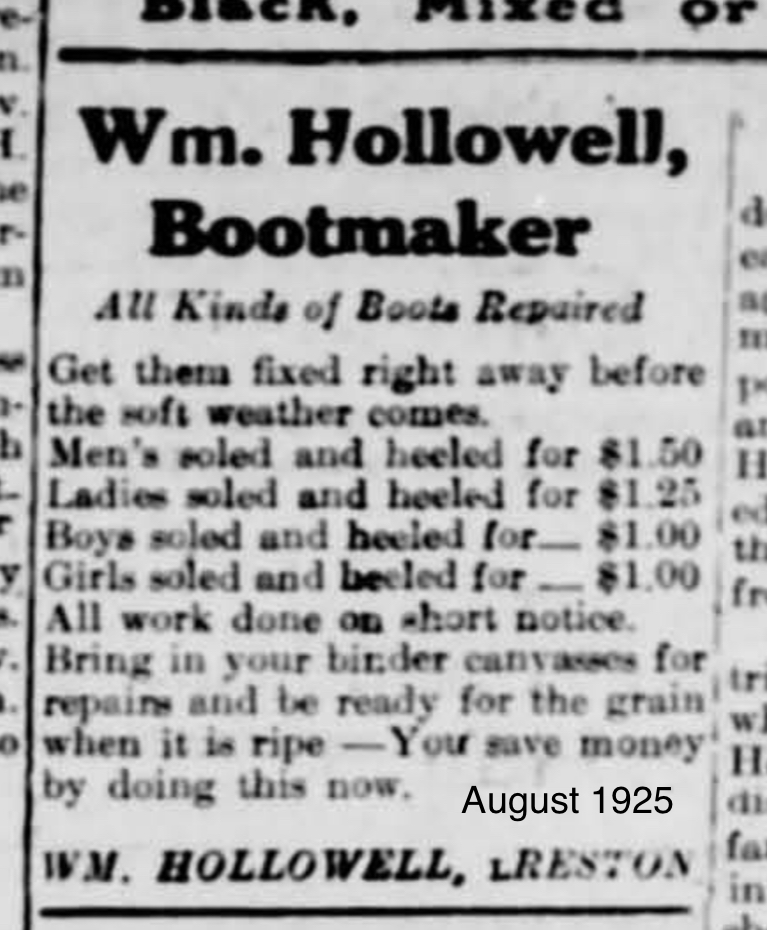
Harness makers in Reston have been mentioned in previous posts by name of Wilkins and Youngs. Today's post covers two men who worked in leather as well and specialized in goods no longer available for purchase in Reston - shoes and boots. These two William Hollowell and Louis Ranger were in business at the same time and their ads in the March 1923 Reston Recorder showed up side by side below.


William Louis Ranger and his wife, Jessie Matilda Lelonde came to the Sinclair district from Brightside, Lanark, Ontario in 1908. The couple had two sons and six daughters between 1909 and 1923. He worked at Sinclair and Tilston before moving to Reston in 1910 and operating a harness repair shop for the next 44 years, until 1954.  His ad below from the 1920 Reston Recorder indicates he has purchased the boot and shoe repair business of Mr. D. Gardner. Equipment would have included heavy duty sewing machines, various hammers, awls and lasts or forms for the leather to be molded around.  He makes the valid point in his ads that repair is cheaper than buying new boots plus they are already broken in and comfortable on your feet. The shop was built in the late 1890's and was located on the west side of Main Street just south of the Dennis County Cafe. 


 Notice the ads above change the order of his initials from W.L. to L.W.  I have seen his name written Louis but his son is written Lewis.  He had another son Orval, also spelled Orville.  None of the family took up the leather trade in Reston but most ended up moving farther west to Broadview and the coast. The handwritten receipt to the right from August 26, 1948 is made out to T.E.B. (Thomas Edwin Boulton) from W. L. Ranger for $1.60.  Your guess is as good as mine concerning the  "1 1/2 c" though.  


William Hollowell is mentioned in the first Trails Along the Pipestone page 483 as living in New England, Reston's settlement south of the tracks. Ted Haines built a house about half a mile south of the tracks in Reston's early days and he contacted his friend Bill Hollowell back in Kent, England to say a shoemaker was needed in the growing railway town. Bill, his wife Mary and their 7 children arrived in 1906 and his shop was on the southeast corner of Main Street for many years after.


William Hollowell supposedly made shoes for the 8 foot tall Bardal Giant, Erwin "Hi" Johnson, as remembered in these clippings from the 1972 Recorder and his obituary from 1993. 


The end of the horse era and farming and move to ready made footwear meant the end of the cobbler trade in Reston. I hope you enjoyed today's walk into the past!